EMPOWERMENT

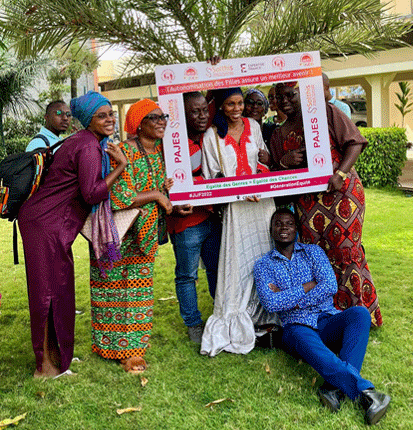
As part of its health promotion efforts, Solthis has developed expertise in empowering both civil society organizations and individuals, enabling them to define their own needs and promote their vital role.

What is empowerment in health?

Empowerment in health aims to enable individuals, communities, and organizations to better understand their needs, make informed choices, and take an active role in decisions that affect their health. For Solthis, this approach places people and local stakeholders at the heart of projects so that they can develop their capacities, make their voices heard, and influence the factors that affect their health. It thus helps promote more equitable access to health care and strengthen the role of citizens and service users in health systems.

How does Solthis empower individuals and communities?

Solthis relies on participatory and inclusive approaches that enable those affected to identify their needs, participate in defining solutions, and contribute to their implementation. Empowerment can be achieved, in particular, through skills development, information and access to knowledge, participation in decision-making, the development of the capacity to act collectively, and the recognition of the knowledge and experiences of those involved. This approach is particularly applied when working with patients and service users, community leaders, and civil society organizations.

At what levels does Solthis work to empower people?

Solthis operates at several complementary levels: individual, organizational, and institutional. At the individual level, it strengthens the skills and capacity to act of patients, service users, health professionals, and community leaders. At the organizational level, it supports associations and organizations in developing their skills, operations, and autonomy. At the national and institutional levels, it contributes to dialogue with decision-makers, advocacy, and the development of policies and environments that promote health.

How does empowerment help improve access to health care?

Empowerment enables individuals and communities to better understand their rights and needs, to participate more fully in decisions that affect them, and to take charge of their own health. At the same time, building the capacity of civil society organizations and fostering their participation in dialogue with institutions helps make health systems more responsive to the needs of the population. This approach thus promotes health services that are better tailored to needs, greater citizen participation, and a better consideration of health inequities.

Solthis - Supporting civil society
Supporting civil society

Solthis provides support to civil society organizations (CSOs) on organizational development, ranging from strengthening their technical expertise to the capacity to obtain direct funding, including capacity in operational research, monitoring and evaluation, administrative and financial management. Our partnership approach also includes the ambition to forge more alliances with advocacy, research and organizational partners, either at national level or more globally.

Individual empowerment

In order for individuals to be informed about the health services available and to be able to make informed choices about their health, Solthis promotes the empowerment of users by enhancing and strengthening their skills. This involves raising awareness and providing health education, but also through enabling individuals to make demands themselves, in order to ensure the promotion of their rights.

Solthis - Individual empowerment
Solthis - Self-care
Self-care

Solthis is particularly committed to self-care issues.
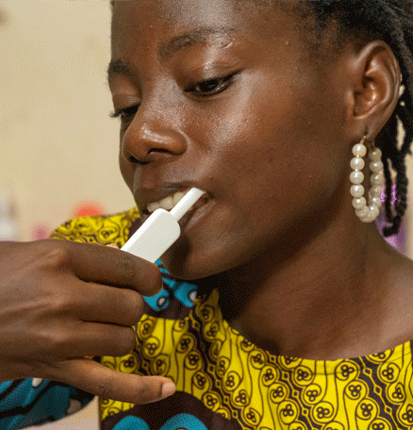
Solthis has developed projects that include this approach (such as HIV self-testing), and reaffirms its importance in improving access to care. Solthis approaches self-care in a holistic way, through the three complementary fields of self-awareness, self-testing, self-care. These approaches are part of our overall approach to health promotion, and we seek to promote meaningful access to a continuum of comprehensive care ranging from self-care to care within the various health facilities.