

The issues
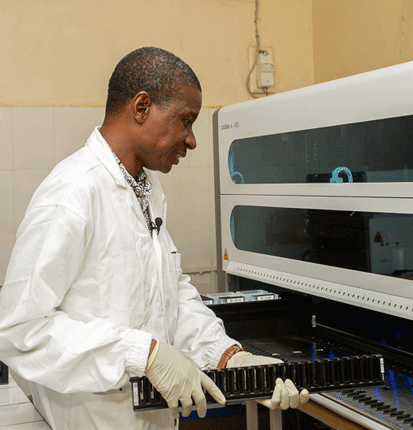
The main issues currently faced by countries with limited resources in the management of health product supplies and stocks are the risk of stock shortages leading to treatment interruptions for patients.
Our priorities
Avoid stock shortages
Enable sustainable access to quality medicines
Ensure the proper use of health products by prescribers, dispensers and patients
Our objectives
- Guarantee the continuous availability of the medicines and healthcare products necessary for patient care
- Ensure their distribution to healthcare sites, guaranteeing their quality at every stage of the supply chain
- Promote the rational use of healthcare products, by supporting healthcare professionals and facilitating patient adherence to their treatments
Our intervention strategy
A systemic approach to the entire management of supplies and stocks + integrate the Supply Chain.
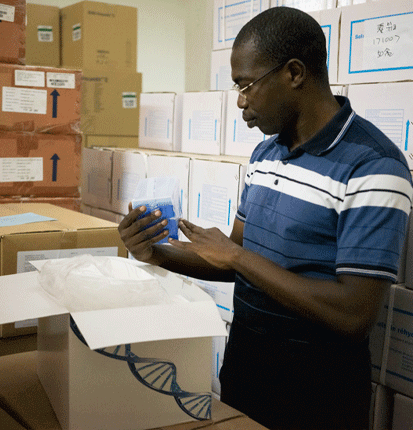
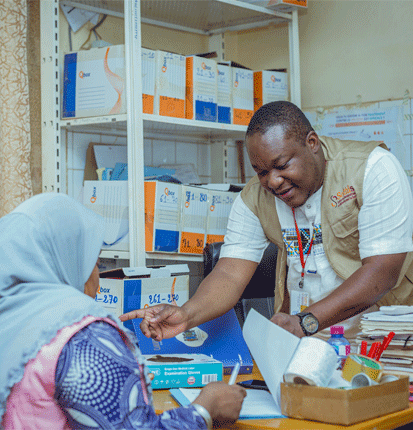
Health professionals with different areas of expertise (both those involved in health promotion and those involved in care -clinicians, nurses, midwives, pharmacists, paramedics) or in the management of health and the health system) have a central place within health systems to guarantee quality services that are as efficient as possible.
Numerous challenges remain for these human resources to be able to fulfil this crucial role, both in terms of quantity (a shortage of qualified human resources and poor geographical spread) and quality (poor performance, insufficient or inappropriate skills).
Several international strategies exist to address the scale of the multiple challenges. Despite Solthis’ desire to adopt a systemic approach to our work, we have chosen to focus on three priority areas:
- Improving the skills of human resources;
- Participating in the (re)definition of tasks between health professionals and the emergence of new functions;
Pursue work initiated on task shifting, including at the community level or by involving patients in certain activities (empowerment). In the context of task shifting to community actors and de-medicalisation, support processes to maximise benefits and minimise risks; - Support the emergence of new functions as has been done in recent years with therapeutic education and psychosocial support;
- Improve the working conditions of healthcare professionals so that individual and collective skills can fully flourish.
The issues
Maintaining and improving the health of the population depends on individuals having fair access to health services offering quality care for the majority of health issues. However, this is not a reality for a significant number of individuals and the quality of care is often sub-optimal.
Several factors may be at the root of this, including:
- Patients who do not always use existing health services, in particular due to a lack of confidence;
- Insufficient numbers of health personnel, who are inadequately trained, unmotivated and poorly paid;
- Health products that are sometimes unavailable and of poor quality;
- Service packages that are unsuitable, unavailable or of uncertain quality:
– lack of comprehensive care
– non-existent biological or imaging tests
– a failing organisation of care, with sometimes compartmentalisation between interventions. This lack of integration sometimes leads to resources and efforts being fragmented;
– data on services and care that are sometimes not recorded, managed or used;
– shortcomings in the leadership of the health authorities, with problems of ownership and a lack of control over the efficiency and quality of care.
Our vision
Improving access to quality health services means working together on:
- The demand for health services;
- The supply of health services.
Our priority objectives
Solthis’ priorities are to help improve the health of individuals by:
- Improving health behaviours through health promotion activities;
- Providing access to a range of appropriate, high-quality, effective, efficient and sustainable health services in a context of limited resources and for priority health issues;
- Developing links between public facilities and community organisations